


The Hired Man
Updated: Dec 5, 2025
Volume XXVI, Issue Four | December 2025
A distant cousin called me last month to tell me his mother had died. We didn’t know each other, but he’d come across a letter I had tucked into a Christmas card last year and thought I ought to know. She was the last of the McCauleys, once a large brood that I remembered from the summers we visited Grandma and Grandpa Dallas. Grandma was a McCauley, and she had seven brothers. (When I can’t sleep, instead of counting sheep, I’d try to recall their names.) I’m sure there are some McCauley relatives out there somewhere, but we’ve lost contact with them.
My Dad’s best friend growing up was Uncle Jack. He was my Dad’s uncle, but he’d been born a little less than a year after my Dad. Grandma said once one of the saddest days of her life was when she was pregnant with my dad and found out her own mother was pregnant. Uncle Jack was the last of Great-grandmother McCauley’s boys. They were known as hellions when they were growing up. One of the family stories was that their father, my great-grandfather, was the sheriff of Eskridge, Kansas. He knew the worst offenders on Halloween night would be his own sons, so he locked them in the house. They escaped, however, and the result was pandemonium.

Of course, Grandma’s brothers were older and settled when I knew them. I remember visiting Uncle Cheed (I think it was) and how he picked a tomato off a vine and handed it to me to eat. When I was eight or nine, I took the train 100 miles east from Denver to Hugo, Colo., where Uncle Ted, another of the brothers, was the station master. Then I’d stay with him and Aunt Effie for a week. I remember those relatives by using their names in my books.
Talking about Uncle Jack with my cousin made me think of Mom’s stories, about how she and Dad, Uncle Jack and his wife, Aunt Margie, got together during that summer of 1933 when my parents lived with my grandparents. Uncle Jack had a job and a car, and he’d pick up my folks, and off they’d go on some excursion.Both my parents had lost their jobs when they married and had moved back to the farm in Kansas.
That was the summer Dad made a total of 50 cents. Their stay on the farm was the basis of my novel The Persian Pickle Club. My folks remained close to Uncle Jack and his wife for the rest of their lives.

This is a long way of telling you about my upcoming book, The Hired Man, but talking with my cousin made me remember why for so long, I’d wanted to write a book about the Dust Bowl. I was born at the end of the Great Depression, but I was seeped in those stories and those values growing up—save your money, pay off the mortgage, make do with what you have, and on and on.
I remember the stories of hardships but also of great happiness, because Mom and Dad had been married just before that 1933 summer. The Dust Bowl wasn’t a time in history for me, it was family stories.
The Hired Man is a story, of course, not a family story but one that I made up. It’s entirely fiction, except that the name of my narrator, Martha Helen, is the name of one of Dad’s cousins.
Here’s how St. Martin’s describes the book:
The Dust Bowl sweeps a handsome stranger into a small Colorado town to dangerous effect. 1937. It’s been seven years since the dust storms started in southeastern Colorado. Folks can barely remember a time when the clouds were filled with rain instead of dirt, and when the fields were green instead of brown. High school student Martha Helen Kessler and her family are luckier than most; they still eke out a living from the land. Even so, evidence of the Dust Bowl’s grim impact on families— especially on the women, who bear the brunt of their husbands’ frustration and their children’s hunger—is everywhere. When Martha Helen’s compassionate mother insists they take in Otis Hobbs, a handsome drifter who saves a local boy from a vicious storm, Martha Helen quickly discovers a darker side to their rural community. Suspicion, jealousy, and prejudice grip their neighbors—and emotions reach a frenzy after Martha Helen’s best friend, Frankie, disappears and is then found murdered. Ultimately, Martha Helen is forced to make sense of her conflicting feelings and loyalties in order to help find retribution and reconcile the difference between the law and justice. Full of vivid period detail and Sandra Dallas’s trademark focus on the lives of women, The Hired Man entertains and ultimately surprises. ~ St. Martins
We’re already talking about promotion for The Hired Man. I don’t know if I will have many signings (health issues), but I do have a significant one on Saturday, April 25, at Books & Brunch, a PEO benefit in Lakewood, Colo. I’ll post the schedule in my next newsletter and on my website.


Stories On Stage
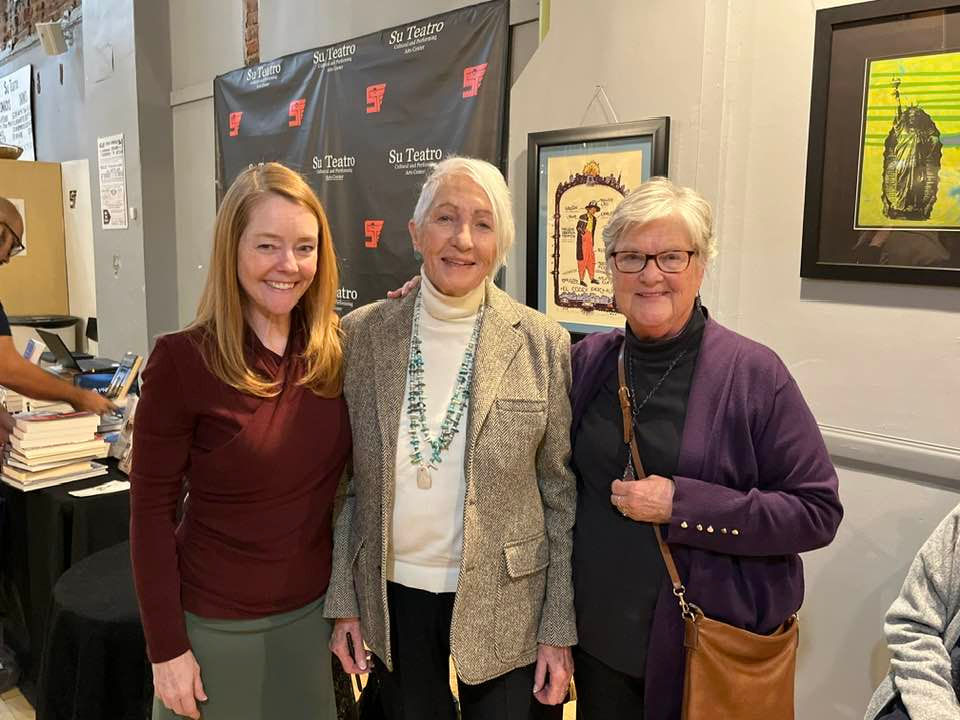
In October, Stories on Stage presented readings from three of my books in an afternoon performance at Denver’s Su Teatre Cultural and Performing Arts Center.
The show was titled “Someplace to Call Home,” which is the title of one of my midgrade novels. The readings were the first chapters of Fallen Women, Prayers for Sale, and the upcoming The Hired Man.
I’ve heard audio versions of my books, but I’ve never heard the words read on a stage. Bob, Povy and I attended, and we were all thrilled with the performances. I wondered, however, why I have so little humor in the beginnings of my books! I’m grateful to everyone who made the afternoon such a success.

Sandra’s Picks
I Never Promised You A Rose Garden
By Joanne Greenberg
St. Martin’s Paperbacks
Last year, Joanne Greenberg and I were speakers at a writers’ conference in Idaho Springs. As two older and perhaps somewhat jaundiced, authors, we took an instant liking to each other and have become friends. Joanne gave me copies of two of her books.
I’ve read (and reviewed) Joanne’s books in the past, and reading these
two made me realize again what an extraordinary writer she is. She tackles tough subjects and doesn’t hold back on making them realistic. Her I Never Promised You a Rose Garden opened my eyes to mental illness and the attitudes we have toward those who are afflicted. Even more so, her In This Sign made me look at how I am barely aware of the challenges of the deaf.
You’ve probably read I Never Promised You a Rose Garden or at least, have seen the movie, but you may not know In This Sign. The story is about Abel and Janice, both deaf, who communicate through sign language. They marry in the 1920s and have a hearing daughter. Both parents are intelligent, but their handicap keeps them trapped in low-level jobs. Early on, Abel is tricked into signing a loan for a car. Payments hang over their heads for years, keeping them in poverty. Living with parents who are unable to hear is crippling for their daughter, who is their conduit to Outside.
Joanne, who learned to sign years ago when her husband worked with deaf people, doesn’t sugarcoat anything in her books. That is why they are so disturbing—and so profound.


